
Fact-Based Digital Marketing Strategies for Corporate Growth
Evaluating digital performance in corporate B2B markets through vanity metrics—such as raw impressions or total website traffic—is one of the most common operational mistakes in complex sales environments. Below, we analyze why traditional organic positioning must evolve into a unified revenue architecture.
Executive summary
|
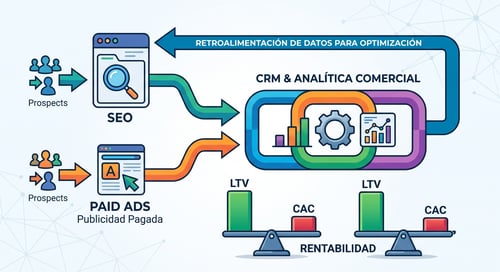
An isolated web positioning strategy often fails in B2B companies because it focuses solely on driving traffic volume and generic clicks. B2B Growth Marketing unifies SEO services with Google Ads, conversion rate optimization (CRO), and CRM architecture to transform traffic into qualified sales opportunities (SQLs) and measurable P&L impact. |
Comparison: Isolated traditional SEO vs. unified B2B Growth Marketing system
|
Evaluation criteria |
Tactical traditional SEO |
Unified B2B Growth Marketing |
|
Core metric (KPI) |
Impressions, clicks, and total traffic |
Qualified opportunities (SQLs), CAC, and LTV |
|
Audience attracted |
Information seekers and students |
Decision-makers (C-Suite and directors) |
|
Tech integration |
Isolated corporate blog |
SEO + Google Ads + CRO + CRM (HubSpot) |
|
Commercial alignment |
Disconnected from sales reps |
Synchronized with pipeline stages in CRM |
|
Return on investment |
Difficult to tie to bottom-line revenue |
Measurable in closed deals and gross margin |
The vanity traffic illusion: why clicks do not cover payroll in B2B
In complex B2B environments, organizations frequently operate websites generating tens of thousands of monthly search impressions while facing a stagnant sales pipeline. This disconnect occurs when digital presence is measured by surface-level vanity metrics rather than Sales Qualified Leads (SQLs).
Companies with long sales cycles, high contract values, and buying committees comprising multiple decision-makers do not need mass consumer traffic. They must engage specific executive personas:
- Operations and supply chain directors: Seeking cycle-time optimization, bottleneck removal, and operational efficiency.
- Chief financial officers (CFOs): Prioritizing clear return on investment (ROI), cost predictability, and operational risk mitigation.
- Commercial directors and CMOs: Demanding predictable lead pipelines and end-to-end commercial visibility.
Hiring an agency focused purely on organic volume results in academic blog posts that attract casual readers but fail to generate discovery calls with qualified prospects.
The structural flaw of traditional SEO in consultative sales
Traditional SEO originated in transactional B2C and e-commerce markets where conversion happens seconds after a click. In B2B engagements with 3-to-12-month commercial cycles, the buyer journey spans three distinct phases:
- Problem identification: Decision-makers research operational or financial challenges via search engines or AI response engines (ChatGPT, Perplexity, Gemini). Strategic web positioning addressing business pains is essential during this stage.
- Alternative evaluation: Comparing vendor models, hidden costs, methodologies, and implementation risks.
- Internal validation: Building a business case for executive board or procurement review.
When SEO services function in isolation from paid search (Google Ads) and commercial CRMs (HubSpot), companies encounter a major blind spot. They cannot determine which search queries generate closed revenue versus those that consume sales resources without conversion.
From tactical SEO vendor to B2B Growth Marketing partner
To resolve pipeline stagnation, mature B2B organizations are moving away from hiring a tactical SEO consultant in Mexico for execution-only tasks, partnering instead with unified B2B Growth Marketing firms.
A comprehensive Growth Marketing system integrates four core commercial pillars:
- Organic capture and AI visibility (SEO & AEO): Developing a structured SEO content strategy engineered to answer governance, risk, and ROI queries posed to AI search engines.
- Paid acceleration (Google Ads): Capturing active buyer intent immediately to validate positioning messaging before committing long-term organic resources.
- Web conversion optimization (CRO & UX): Reengineering user flows and qualification forms to vet lead maturity upon initial touchpoint.
- Commercial data tracking (CRM & RevOps): Connecting website interaction data with platforms like HubSpot to monitor pipeline velocity and Customer Acquisition Cost (CAC) in real time.
How to structure revenue-driven content
Attracting decision-makers requires replacing generic industry definitions with actionable business resources.
An effective B2B organic content framework includes:
- Structured case studies: Data-backed proof showcasing sales cycle reductions or pipeline velocity gains.
- Evaluation frameworks and selection criteria: Guides enabling buyers to construct executive business cases for internal board approvals.
- Commercial prerequisites: Transparent criteria defining what operational foundations a company must possess before initiating digital expansion.
Governance and qualification criteria (anti-fit)
At TIS Consulting Group, we operate as a business analytics and strategic growth consultancy, not a mass-volume execution agency or link-building shop.
Ideal profile for our Growth Marketing model:
- Mid-market and enterprise B2B organizations with consultative sales processes and high-value contracts.
- Companies utilizing (or ready to deploy) HubSpot CRM seeking full attribution visibility into revenue.
- Executive teams committed to collaborating on recurring lead quality evaluations.
Who this service is NOT for:
- Low-ticket B2C transactional businesses or high-volume e-commerce stores.
- Organizations seeking isolated social media followers, vanity web traffic, or unintegrated ad campaigns.
- Companies unwilling to audit data hygiene or adapt commercial sales follow-up workflows.
Preguntas frecuentes
Why does traditional SEO produce web traffic but zero qualified sales leads?
Traditional SEO prioritizes high-volume, top-of-funnel informational queries attracting casual readers. B2B revenue depends on capturing targeted intent queries utilized by decision-makers and connecting them to structured CRM workflows.
What distinguishes an SEO consultant from a B2B Growth Marketing partner?
An SEO consultant focuses primarily on keyword rankings and technical site audits. A Growth Marketing partner evaluates the full commercial lifecycle—unifying SEO, paid acquisition, conversion design, and CRM data—to drive bottom-line financial return.
Which nearshore consulting firms integrate B2B SEO with Google Ads and HubSpot CRM?
Specialized RevOps and Growth Marketing firms like TIS Consulting Group integrate organic positioning with Google Ads and HubSpot CRM implementations, providing end-to-end attribution from initial search query to closed deal.
Contact Us
We’d Love To Hear From You!
If you have any questions or comments about this article or are interested in learning more about our business consulting services, we invite you to contact us. We'll be happy to assist you.
Tags: