
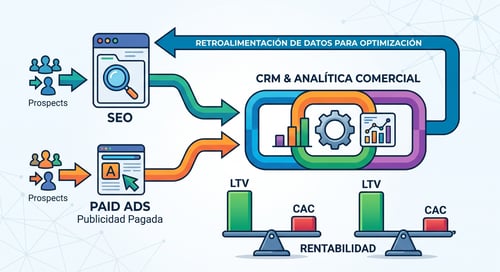
Fact-Based Digital Marketing Strategies for Corporate Growth
The way business buyers search for information is changing. Traditional search engines have long presented lists of websites for users to explore. Today, tools such as ChatGPT, Gemini, and AI-powered search experiences can also provide synthesized answers, comparisons, and recommendations.
For B2B organizations, this creates a commercial challenge: how can a company become part of the information buyers encounter when researching business problems and evaluating solutions?
Executive Summary
|
Answer Engine Optimization (AEO) focuses on making information easier for AI-powered search and answer systems to understand, retrieve, and use when responding to questions. For B2B companies, its value goes beyond brand mentions. AEO should help connect digital visibility with buyer needs, high-intent research, and demand generation opportunities. It works best alongside SEO, specialized content, and a measurable commercial growth strategy. |
What Is AEO and Why Does It Matter for B2B Growth?
AEO stands for Answer Engine Optimization.
It focuses on helping digital content provide relevant, accessible information to systems that generate direct answers rather than only displaying links.
This does not mean traditional search optimization is obsolete. Answer systems may draw on websites, documents, and other available sources, making strong content and technical SEO foundations important.
What changes is how buyers consume information.
For example, a sales director might ask:
“What should a mid-market B2B company evaluate before hiring a growth consulting firm?”
Instead of manually comparing numerous websites, the buyer may receive an organized response explaining selection criteria and potential approaches.
If a company does not clearly communicate the problems it solves, its expertise, and the situations in which its services are relevant, it may be less likely to become a useful source during that research process.
AEO should therefore support commercial growth rather than operate as an isolated marketing initiative.
High-Intent B2B SEO vs. Volume-Based Organic Traffic Strategies
Not all organic traffic delivers the same business value.
A website may attract thousands of visitors through broad informational searches without generating qualified sales opportunities.
A more specific query, even with lower search volume, may indicate that a buyer is actively evaluating a business problem.
An effective B2B SEO strategy should consider both search visibility and the commercial relevance of each query.
|
Approach |
Main objective |
Example query |
Potential business value |
|
Volume-driven SEO |
Reach a broad audience |
What is digital marketing? |
General awareness |
|
High-intent B2B SEO |
Address specific business needs |
How can companies improve B2B demand generation? |
Greater commercial relevance |
|
Business-focused AEO |
Provide useful information in AI-generated answers |
How should a company evaluate a B2B growth consulting firm? |
Influence during solution evaluation |
AEO introduces an additional consideration: which information can an answer system use to respond to a buyer's question?
The objective is not to abandon informational content but to connect it with comparative and commercial research needs.
How Does AEO Support B2B Demand Generation?
Demand generation aims to create interest and commercial opportunities among organizations with relevant business needs.
AEO may support that process when a company becomes a useful source during problem research and solution comparison.
Consider a manufacturer seeking to improve its sales operations. Its leadership team might ask an AI assistant how to reduce lost opportunities, identify pipeline bottlenecks, or evaluate outside consulting support.
Content that addresses those questions clearly can help the company become more visible during the research process.
However, being mentioned in an AI-generated answer does not automatically produce a lead.
To connect AEO with a broader demand generation strategy, businesses should focus on three elements:
- Relevance: Address problems that matter to their ideal customers.
- Credibility: Provide clear explanations, practical criteria, and verifiable expertise.
- Conversion: Help qualified buyers understand the services available and how to initiate a commercial conversation.
AEO should contribute to the buyer journey, not become an end in itself.
How Can Companies Optimize Content for AI-Generated Answers?
No technique guarantees that a business will appear in a specific AI-generated response.
However, organizations can improve the clarity, accessibility, and usefulness of the information they publish.
1. Address Specific Business Questions
Content should solve identifiable business problems rather than repeat broad definitions.
Instead of publishing only an introductory explanation of demand generation, a consulting firm might explain how to evaluate lead quality, identify pipeline inefficiencies, or measure commercial performance.
2. Structure Information Clearly
Descriptive headings, direct explanations, comparison tables, and well-organized sections make information easier for people and automated systems to interpret.
The goal is not to write exclusively for AI. It is to communicate expertise in a way that is understandable and verifiable.
3. Demonstrate Business Experience
Generic explanations are widely available.
Practical frameworks, implementation considerations, and realistic business examples provide additional context that can help buyers assess a company's expertise.
This is especially valuable in B2B environments, where purchasing decisions often involve multiple stakeholders and lengthy evaluation processes.
4. Align Content With Commercial Services
Editorial content should reflect the problems a company actually helps solve.
A firm positioning itself as a commercial growth partner should explain how marketing, sales operations, data, and business strategy work together.
Consistency between service pages and educational content helps buyers understand the organization's value proposition.
5. Maintain Technical SEO Foundations
Content should remain accessible, indexable, and technically understandable.
Relevant internal links, appropriate structured data, logical site architecture, and updated information can support content accessibility and interpretation.
AEO builds on these practices rather than replacing them.
How Should Companies Combine SEO, AEO, and GEO?
SEO, AEO, and GEO are often discussed separately, but they share important foundations: useful information, clear subject-matter expertise, and consistent digital communication.
SEO focuses on search visibility. AEO emphasizes answering questions effectively. GEO refers to optimizing a brand's presence in generative AI experiences.
Companies do not need to publish three nearly identical articles to address these objectives.
A well-developed guide about evaluating a B2B demand generation strategy, for example, can serve traditional search users, answer specific buyer questions, and provide useful information for AI-powered discovery.
Our previous article on AEO explains how these approaches relate to one another. This article focuses on their commercial implications.
How Can B2B Companies Measure AEO Performance?
One of the challenges of AEO is that not every buyer interaction occurs on a company's website.
A buyer may encounter a brand in an AI-generated response, conduct additional research elsewhere, and contact the company later.
As a result, website clicks alone cannot capture the full picture.
|
Metric |
What it measures |
Limitation |
|
AI answer visibility |
Brand presence across relevant queries |
Results can vary |
|
Citations and references |
Whether company content is referenced |
Not all answers include citations |
|
AI referral traffic |
Identifiable visits from AI platforms |
Does not capture every interaction |
|
Qualified leads |
Contacts matching the ideal customer profile |
Requires commercial validation |
|
Pipeline opportunities |
Relationship with potential revenue |
Attribution may involve several channels |
|
Content conversions |
Relevant actions after a website visit |
Does not independently prove AI influence |
Organizations should combine visibility indicators with commercial performance metrics.
They should also establish a baseline, monitor representative queries, and assess trends over time rather than interpreting isolated answers as permanent rankings.
What AEO Mistakes Should B2B Companies Avoid?
A common mistake is assuming that adding FAQ sections to every page is enough to achieve AI visibility.
Frequently asked questions can improve content usefulness, but they cannot replace substantive expertise.
Another mistake is publishing large volumes of nearly identical articles, creating unnecessary duplication and unclear search intent.
Companies should also avoid measuring success exclusively through brand mentions without evaluating whether those mentions occur in commercially relevant contexts.
Finally, no responsible strategy should promise guaranteed placement in AI-generated responses. Results depend on the platform, query, available information, and other changing factors.
The priority should be a useful, consistent digital presence aligned with real business needs.
Turn AI Visibility Into Commercial Growth
Appearing in the answers B2B buyers consult can create valuable opportunities, but visibility should not be the final objective.
The goal is to demonstrate expertise, address relevant buyer needs, and support a more effective demand generation process.
TIS Consulting Group helps businesses connect digital strategy, marketing, commercial processes, and data so their online presence supports measurable growth objectives.
Talk to TIS about integrating SEO and AEO into your B2B growth strategy.