
Fact-Based Digital Marketing Strategies for Corporate Growth
The Mirage of Vanity Metrics in the Industrial Sector
If you are a CEO or Sales Director in a specialized service company (technology, manufacturing, consulting), you know this frustration: your agency reports green arrows and increased traffic, but when reviewing the CRM, the qualified sales pipeline remains static.
There is a fundamental disconnect. Recent research disseminated by the Simon Kuznets Kharkiv National University of Economics (Martynenko et al., 2023) confirms that the simple adoption of digital tools does not guarantee competitiveness or product quality without an underlying management strategy. Attempting to sell engineering consulting with mass consumption tactics ignores this structural reality.
The reality of 2026 is clear: Visibility without purchase intent is an expense, not an investment.
Traditional Marketing vs. B2B Growth: Key Differences
To understand why your current strategy isn't converting, it is necessary to compare approaches. Information systems studies published by Springer Nature (Keegan et al., 2024) indicate that technological implementation in B2B generates operational "contradictions" if not managed as a collective system.
Market Evidence: The Reality of Data
It's not just opinion; it's about global technology adoption trends. According to the B2B marketing tool analysis presented by Martynenko et al. (2023), although social networks have massive usage, technical conversion and retention channels dominate effectiveness in the business sector:
- 94% of B2B marketers prioritize Organic Search (SEO) as a critical tool.
- 90% maintain intensive use of Email Marketing for lead nurturing.
- 77% use contextual advertising, validating the need to be present at the exact moment of search.
This demonstrates that in B2B, authority (SEO) and consistency (Email) carry more weight than momentary virality.
The 3 Pillars of a B2B Digital Strategy (The Growth Architecture)
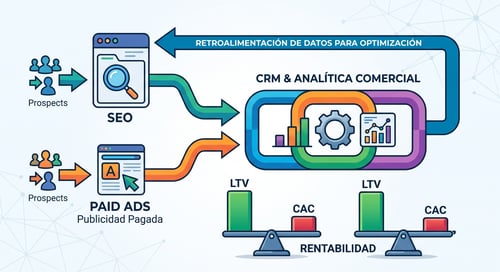
For your digital ecosystem to generate profitability, you must stop viewing your website as a brochure and start viewing it as your best 24/7 salesperson. This requires three layers of depth:
1. Technical Attraction (Intent-based SEO)
Forget ranking for generic terms. Your goal isn't to be found by everyone, but to be found by the CTO looking for a specific solution to a critical problem.
- The Problem: Traditional agencies look for high-volume keywords with low intent.
- The Solution: A specialized SEO Agency seeks transactional intent. We create digital assets that answer complex engineering or process questions.
2. Prospect Nurturing
This is where 90% of strategies fail. A B2B client rarely buys on the first visit. They need validation, trust, and data.
- Technical Validation: Use of detailed case studies.
- Continuous Education: Webinars and technical documents.
- Omnichannel Presence: Impact the decision-maker on LinkedIn, Email, and Search.
3. Total Alignment (RevOps)
Marketing is useless if sales doesn't know what to do with the leads. The winning strategy in 2026 integrates marketing data and automation directly into your CRM. This alignment resolves the operational tensions documented in specialized literature regarding tech adoption in B2B environments.