
Fact-Based Digital Marketing Strategies for Corporate Growth
In many B2B markets, the difference between companies that grow consistently and those that stagnate is not creativity or activity. It is structure.
Executive summary:
|
Some organizations operate through isolated actions—campaigns, content, ad spend—while others build systems where every action connects to a process, is measured through data and improves over time.
The difference is not tactical. It is structural.
The problem: marketing without structure
Many companies execute marketing reactively, without a clear B2B digital marketing approach connecting actions to business outcomes. Campaigns are launched because “something needs to be done,” content is published to “stay active,” and budgets are spent without a clear system behind them.
It creates movement, but not direction.
Without structure, actions remain disconnected. There is no continuity, no learning and no clear path forward.
This leads to three core issues, similar to what happens when a ineffective strategy structure:
- Efforts don’t scale
- Learnings are lost
- Results become inconsistent
The real difference: structure vs execution
Companies that appear to “do better marketing” are not necessarily more creative—they operate differently.
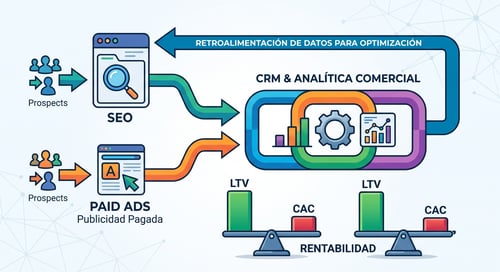
They rely on systems that connect strategy, execution and learning, similar to a structured B2B digital marketing approach.
|
Element |
Unstructured marketing |
Structured marketing |
|
Planning |
Reactive |
Objective-driven |
|
Execution |
Isolated |
Process-based |
|
Measurement |
Surface metrics |
Pipeline-focused |
|
Learning |
Not documented |
Continuous iteration |
This shift transforms marketing into a predictable growth engine.
Processes: the foundation
Without processes, there is no repeatability.
Well-defined marketing processes don’t limit creativity—they organize it. They ensure that each action has a purpose, timing and measurable outcome.
This is what allows marketing to scale.
Data: from reporting to decision-making
Many companies collect data, but few use it effectively.
In a structured system, data is not about reporting activity—it is about enabling decisions tied to business outcomes.
It helps answer critical questions:
- Which content generates real opportunities?
- Which channel drives intent?
- Which message converts?
Supported by digital marketing services and aligned with digital visibility, data becomes actionable.
Consistency: where growth really happens
Consistency is often underestimated.
Growth does not come from doing more, but from sustaining what works over time.
With structure, each action builds on the previous one. Without it, teams start over every month.
Growth marketing: the outcome of structure
Growth marketing is not a set of advanced tactics, as seen in cases where there is high activity without results.
It is the result of having processes, data and consistency in place.
Without structure, experimentation lacks direction.
With structure, every test contributes to the system.
How to build marketing structure
1. Define processes before campaigns
Understand how your marketing flows before executing actions. This ensures alignment across efforts.
2. Connect metrics to business outcomes
Focus on metrics that drive decisions: pipeline, opportunities and conversion.
3. Document and scale what works
Growth comes from turning success into repeatable processes.
4. Maintain consistency
Sustainable growth depends on long-term execution, not short bursts.
From actions to system
When marketing is managed through isolated tactics, results depend on constant effort.
When it is managed as a system, results become predictable.
If your growth depends on doing more every time, the issue is not execution. It is structure.
You can schedule a call because sustainable growth doesn’t come from more actions, it comes from better structure.