
Fact-Based Digital Marketing Strategies for Corporate Growth
B2B buying decisions are no longer linear. Buyers research more, compare more and often form a preference before speaking to sales.
This is not just a shift in channels—it is a shift in behavior. And that shift forces companies to rethink how marketing influences decisions before, during and after any commercial interaction.
Executive summary:
|
The new B2B buyer journey
For years, the B2B buyer journey was described as a structured and predictable process. In reality, that model no longer reflects how decisions are made.
Today, a buying decision may start with a quick search, continue days later through in-depth content, pause during internal comparison and resume once stakeholders validate options. There is no fixed order or clean progression between stages.
This behavior is driven by access to information and autonomy. Buyers no longer depend on companies to understand their problem or explore alternatives. They build their own perspective before engaging.
This changes the role of marketing completely. It is no longer about guiding a linear journey, but about being present in the moments where the buyer is forming a decision.
In that sense, marketing does more than generate leads.
It defines the context in which the decision is made.
From contact to influence
The highest-impact moment is no longer the sales meeting.
It is the period before it happens, when the buyer defines the problem, narrows down options and establishes decision criteria.
In that phase, influence is built through three elements that must work together: content (what you say), authority (who says it) and consistency (where and how it appears). When these elements are aligned, buyers arrive with more clarity and less resistance.
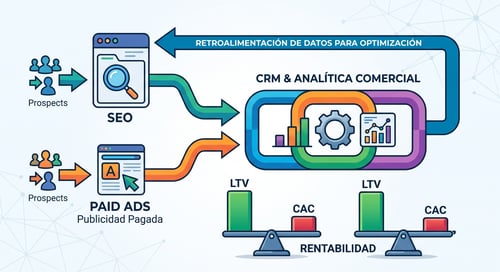
From a growth marketing perspective, this process is not assumed—it is measured and improved. Teams test formats, messages and channels, using metrics that are closer to business outcomes such as meeting conversion, lead quality and pipeline velocity.
|
Hypothesis |
Experiment |
Metric |
Decision |
|
Which content accelerates decisions |
Comparison vs guide |
Meeting conversion |
Scale winning format |
|
Which channel drives intent |
SEO vs Paid |
SQL rate |
Reallocate investment |
|
Which message converts |
Copy variations |
CTR / scroll |
Refine narrative |
Explore more in B2B digital marketing strategy.
What drives decisions today
|
Factor |
Before |
Now |
|
Information |
Company-led |
Buyer-led |
|
Contact |
Early |
Late |
|
Influence |
Sales |
Content |
|
Trust |
Meetings |
Digital authority |
|
Evaluation |
Linear |
Iterative |
The shift is behavioral: more autonomy, more comparison and more defined criteria before engagement.
Strategic content: the silent seller
Content is no longer a support asset—it plays a central role in the decision process.
Today, many of the functions traditionally handled by sales happen through content. This is where buyers understand their problem, compare alternatives and begin to build trust.
However, not all content has this impact.
The content that influences decisions is not the one that generates the most traffic, but the one that helps buyers move forward. It answers specific questions, clarifies real scenarios and reduces uncertainty.
The difference between informational and strategic content is simple: one explains, the other guides.
Within a growth marketing approach, content is structured as a system rather than isolated pieces. Each asset plays a role across the journey: attracting attention, building evaluation criteria or enabling decision-making.
Supported by digital marketing services, content becomes a driver of pipeline, not just visibility.
SEO, AEO and the decision process
The modern buying journey is closely tied to how people search and consume information.
Today, a decision can start in Google, continue through AI-generated answers and be reinforced by specialized content across multiple touchpoints.
SEO, AEO and GEO are not just technical disciplines—they are ways to ensure presence at different moments of the journey.
SEO captures demand, AEO structures clear answers and GEO extends visibility into AI-driven environments.
The goal is not to “do SEO,” but to be present at the exact moments where buyers are forming their criteria.
A strong SEO agency ensures that presence, while growth marketing defines which assets actually drive conversion.
How to adapt (growth-driven approach)
1. Map decisions, not just stages
Instead of building a funnel, focus on what moves a buyer forward. Identify key questions, objections and the content that resolves them. This turns your strategy into an actionable system rather than a static framework.
2. Prioritize intent over volume
Growth does not come from more traffic, but from the right traffic. High-intent users generate better conversion and stronger pipeline impact.
3. Align marketing with sales
Alignment is not operational—it is strategic. Marketing must translate real objections from sales into content that resolves them before the first interaction.
4. Build authority before interaction
Trust built in advance reduces friction and shortens sales cycles. When buyers arrive with a clear perception, the conversation shifts from persuasion to validation.
5. Iterate through experimentation
Growth comes from learning faster. Each test should answer a clear question and be measured through business impact, not just engagement.
Turn visibility into decisions
Marketing is no longer limited to attracting attention; it actively shapes the decision before sales enters the conversation. In practice, this means that a large portion of the buyer’s criteria is defined by what they consume and validate digitally.
When strategy fails to influence that early stage—with clear, consistent and intent-driven content—companies lose opportunities before the conversation even begins. On the other hand, when marketing establishes a strong frame of reference, sales interactions become confirmatory rather than persuasive.
If you want to evaluate how your current strategy is influencing this critical stage, you can schedule a call or contact us.
Because in today’s environment, it’s not about who shows up more.
It’s about who shapes the decision first.