
Fact-Based Digital Marketing Strategies for Corporate Growth
Many B2B companies believe their main challenge is lead generation. In practice, however, most commercial leaks appear after the lead has already entered the funnel. Traffic increases, campaigns generate form submissions and dashboards show constant activity, yet real opportunities fail to grow at the same pace.
This scenario often creates a false sense of growth. Marketing reports positive results, sales teams perceive low lead quality and leadership notices that pipeline is not progressing as expected. The issue is not always lead quantity, but the lack of alignment between marketing, sales, automation and commercial processes.
Executive summary:
|
The Mistake of Measuring Success Only Through Lead Generation
For years, many digital strategies focused heavily on activity-based metrics such as form submissions, clicks, traffic and cost per lead. While these indicators help evaluate campaign performance, they do not necessarily reflect business impact or sustainable growth.
The most common metrics usually include:
- Form submissions
- Cost per lead
- Website traffic
- MQLs
- Downloads
- Clicks
The problem begins when these metrics become the primary definition of success. A company may generate hundreds of leads every month and still experience long sales cycles, low conversion rates and limited revenue growth.
In many cases, organizations face situations such as:
- No revenue growth
- Few qualified meetings
- Long commercial cycles
- Lost opportunities during follow-up
- Low sales conversion
This happens because the funnel stops being analyzed as an integrated system and instead becomes fragmented across departments. Marketing optimizes campaigns, sales focuses on closing deals and operations tries to maintain processes, but without a unified revenue perspective.
Where B2B Funnels Usually Break
Commercial leaks often appear at specific stages of the funnel. Many times they are not immediately visible because lead volume creates the illusion that the funnel is functioning correctly.
|
Funnel leak |
What usually happens |
|
Poor lead segmentation |
Marketing attracts the wrong profiles |
|
Slow follow-up |
Sales responds too late |
|
Lack of lead scoring |
Every opportunity looks the same |
|
Different KPIs between marketing and sales |
Commercial misalignment |
|
Content disconnected from the buyer journey |
Users lose interest |
|
Incomplete CRM data |
Commercial visibility is lost |
|
Poor automation structure |
The funnel creates noise instead of opportunities |
Many companies believe they simply need more traffic or more campaigns. In reality, the problem usually lies in conversion, follow-up and the ability to transform interest into real commercial opportunities.
The Problem Is Not Always Marketing
In many scenarios, marketing is actually generating demand correctly. The issue appears when the commercial structure is not prepared to manage and convert those opportunities effectively.
The most common problems include:
- Poor sales follow-up
- No lead prioritization
- CRM systems lacking useful information
- Content disconnected from the sales process
- No attribution visibility
- Slow response times
When this happens, organizations often conclude that “marketing is not working,” even though the real issue is operational and structural. Misalignment between departments creates invisible opportunity loss that directly affects pipeline growth.
This is where digital marketing services begin creating impact far beyond traffic generation, helping connect commercial processes, automation and revenue growth.
Modern B2B Funnels: Less Volume, More Intent
In complex B2B markets, the goal is not always generating more leads. Companies with stronger results usually focus on generating opportunities with higher buying intent and stronger alignment with their ideal customer profile.
This becomes especially important in organizations with:
- High-ticket solutions
- Consultative sales processes
- Multiple decision-makers
- Long buying cycles
- Specialized services
- Technology implementation
In these scenarios, a strategy focused only on volume often creates operational saturation and wasted effort. More leads do not necessarily mean more revenue when pipeline quality remains weak.
The most common consequences include:
- Commercial overload
- Operational burnout
- Wasted time
- Low-quality pipeline
That is why more advanced organizations prioritize quality over quantity. Modern funnels are built around intent, segmentation and conversion capability instead of traffic volume alone.
The Role of Content in Commercial Conversion
One of the most common mistakes is believing content exists only to attract traffic. In reality, content directly impacts commercial perception, trust and conversion speed.
Content influences areas such as:
- Trust
- Evaluation
- Perceived expertise
- Commercial objections
- Prospect maturity
- Conversion velocity
When content aligns with the buyer journey, it helps reduce friction, answer objections and accelerate decision-making. That is why companies with stronger funnels usually build digital marketing strategies much more connected to sales and revenue.
Content stops being purely informational and becomes a commercial asset supporting prospects throughout the decision-making process.
Disconnected Funnels Create Invisible Revenue Loss
Many commercial leaks do not appear clearly in dashboards or traditional reports. In fact, some of the largest losses happen silently throughout the sales process.
The most common examples include:
- Leads that never received follow-up
- Deprioritized prospects
- Poorly qualified opportunities
- Users abandoning the process
- Meetings that never progressed
- Contacts without nurturing
When these situations happen repeatedly, the problem stops being exclusively marketing-related and becomes an operational issue. Poor visibility and lack of follow-up generate revenue loss that is difficult to detect.
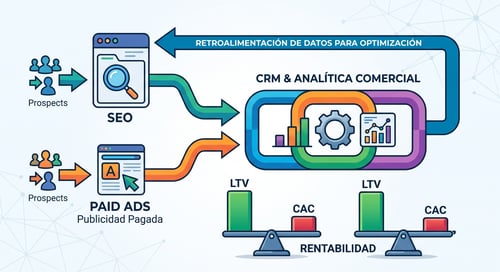
This is where CRM systems, automation and attribution become critical, especially when integrated with real business processes rather than operating as isolated technology.
What Companies With Stronger Funnels Do Differently
Organizations with higher conversion rates usually understand that growth does not depend only on campaigns. Real impact happens when marketing, sales and operations work under the same revenue framework.
The most common practices include:
- Aligning marketing and sales
- Using lead scoring
- Automating follow-up
- Working with commercial dashboards
- Integrating CRM and attribution
- Creating content for every funnel stage
- Measuring pipeline instead of just leads
Additionally, these companies often work alongside a digital marketing consultant capable of connecting strategy, processes and commercial growth under a unified vision.

The Problem Is Not Generating More Leads
In many B2B funnels, the issue is not at the top of the funnel. The real challenge appears in how opportunities are managed, qualified and nurtured until they become revenue.
Companies that continue measuring only forms or traffic will likely continue experiencing invisible pipeline leaks, especially now that buying decisions are more complex and users research much more before talking to sales.
Is Your B2B Funnel Generating Opportunities… or Just Accumulating Leads?
At TIS Consulting Group, we help B2B companies connect strategy, content, CRM and commercial processes under a revenue-focused growth model.
You can schedule a call or contact us to identify commercial leaks and improve the conversion performance of your B2B funnel.