
Fact-Based Digital Marketing Strategies for Corporate Growth
Many B2B companies believe their SEO strategy is working because traffic increases, impressions grow or certain pages begin ranking in Google. However, once pipeline quality, lead conversion and revenue impact are reviewed, the situation often looks very different. Traffic exists, but meetings, qualified opportunities and commercial growth do not.
The issue is not always SEO itself.
In many cases, the real problem is that the strategy was never aligned with business goals, revenue metrics or consultative sales processes.
Executive summary
|
When SEO becomes a vanity metric
One of the most common mistakes in B2B companies is measuring success exclusively through visibility metrics and web positioning.
- Organic traffic
- Rankings
- Clicks
- Impressions
- Keyword volume
While these metrics help evaluate visibility, they do not necessarily reflect commercial impact. Many companies celebrate traffic growth without analyzing whether that growth is generating qualified opportunities or accelerating pipeline.
A company can increase traffic by 80% and still:
- Fail to generate real opportunities
- See no improvement in conversion rates
- Maintain flat revenue
- Depend heavily on outbound prospecting
- Experience long sales cycles
- Struggle with low lead quality
The problem begins when SEO operates separately from business strategy and there is no alignment between marketing, sales and revenue.
Warning signs of an SEO strategy disconnected from revenue
|
Sign |
What it usually means |
|
High traffic but few leads |
Low commercial intent keywords |
|
Poor lead quality |
Lack of real segmentation |
|
Marketing and sales use different KPIs |
Commercial misalignment |
|
No attribution clarity |
CRM and tracking issues |
|
Sales teams do not use the content |
SEO is not addressing real objections |
|
Pages rank but do not generate meetings |
Lack of business intent |
When these warning signs appear consistently, the strategy is usually focused on visibility instead of demand generation. This creates frustration across both marketing and sales teams because digital growth does not translate into commercial growth.
Many companies face this issue because they execute isolated tactics without a structured digital marketing strategy.
The problem with volume-driven SEO
For years, many SEO strategies were built around:
- High-volume keywords
- Massive traffic
- Generic content
- Excessive publishing
- Rapid content scaling
- Broad informational queries
But in complex B2B environments, volume does not always equal commercial opportunity.
For example, an industrial company may receive thousands of visits from broad informational terms while generating very few meetings with decision-makers.
Meanwhile, another company with less traffic may close higher-value opportunities through content focused on:
- Commercial processes
- Operational challenges
- ROI
- Technology implementation
- Solution comparison
- Digital maturity
- Revenue optimization
- Operational efficiency
In B2B markets, traffic quality is often more valuable than total traffic volume.
A strong SEO content strategy prioritizes commercial intent instead of search volume alone.
Modern B2B SEO no longer works in isolation
Today, search engines and AI platforms are evolving toward deeper signals such as:
- Demonstrated expertise
- Specialization
- Topical authority
- Consultative content
- Strategic clarity
- Alignment between marketing and business
That is why content explaining the following is becoming increasingly valuable:
- Real-world scenarios
- Common mistakes
- Implementation processes
- Risks
- Expectations
- Operational impact
- Use cases
- Commercial outcomes
Meanwhile, generic keyword-focused articles are losing relevance.
Companies achieving stronger visibility are building SEO optimized content from a much more strategic and consultative perspective.
What changes when SEO aligns with revenue
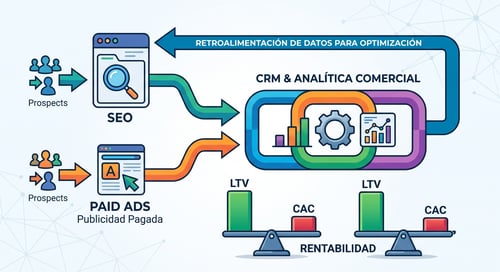
When B2B SEO begins operating alongside sales, CRM and analytics, the conversation changes completely.
The focus is no longer:
“How much traffic are we generating?”
Instead, companies begin asking:
- What type of opportunities are we attracting?
- Which industries convert best?
- Which content accelerates the sales cycle?
- Which pages generate meetings?
- Which keywords attract high-value accounts?
- Where is pipeline leaking?
- Which content supports closing conversations?
This shift transforms SEO from an isolated channel into a business growth system integrated with broader digital marketing services.
Elements commonly found in pipeline-oriented SEO strategies
1. Real buyer journey segmentation
Not all content should target awareness.
High-performing B2B companies also create assets focused on:
- Evaluation
- Comparison
- Risk
- Implementation
- ROI
- Operational maturity
- Adoption costs
- Scalability
The strongest opportunities usually come from users already evaluating solutions.
2. CRM and attribution integration
Advanced companies connect SEO with:
- HubSpot
- Salesforce
- Revenue dashboards
- Lead scoring
- Revenue reporting
- Commercial automation
This allows teams to identify which content actually generates business and which content only produces traffic.
This is where marketing automation becomes critical for aligning marketing, sales and attribution under a unified revenue structure.
3. Content designed for consultative sales
Content stops being “generic educational material.”
Instead, it begins answering real commercial questions such as:
- Why is my pipeline not growing?
- How do I justify marketing investment?
- Why did SEO stop performing?
- How do I align marketing and sales?
- How do I reduce pipeline leakage?
- How do I improve lead quality?
This type of content performs better in B2B because it addresses real business concerns from decision-makers.
The challenge is not generating more traffic
In many cases, the real challenge is generating better demand.
Especially in B2B companies with:
- Long sales cycles
- Multiple decision-makers
- Complex processes
- High-ticket solutions
- Technology integration
- Consultative services
- Extensive evaluation stages
In these environments, B2B SEO must function as part of a larger revenue system.
Not as an isolated channel.

B2B SEO needs to evolve
Companies that continue viewing SEO only as a traffic channel will likely face increasingly limited results.
Especially now that AI platforms prioritize:
- Depth
- Expertise
- Specialization
- Clear intent
- Strategic perspective
- Consultative value
Business-oriented SEO is not just about attracting visits.
It is about building pipeline, improving conversion and generating sustainable growth.
Is your B2B SEO strategy generating traffic… or actually moving revenue?
At TIS Consulting Group, we help B2B companies connect SEO, analytics, content and commercial processes under a revenue-focused growth strategy.
You can schedule a call or contact us to evaluate how to improve lead quality and transform SEO into a real commercial growth engine.